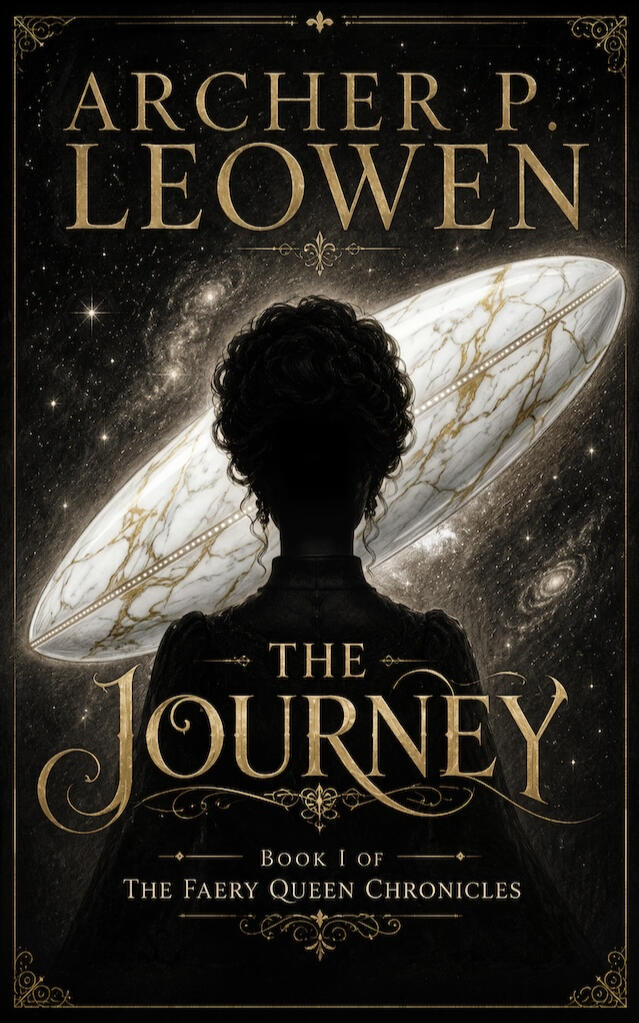
The Faery Queen Facing the Journey

Archer P. Leowen
The Journey
Book I of The Faery Queen Chronicles
The Faery Queen from King Arthur’s legend is given an opportunity she can’t refuse: Create a utopian civilization where mortals thrive on a planet across the universe. Mother Space and Father Time suggest The Queen enlist Earthly mythological entities to help her govern. Their only edict, a blood oath: Protect Life, Enjoy Life.On the Journey to their new home, legendary beings will discover how to be independent from human imagination in order to structure and support an ideal society. But one among The Queen’s trusted company is not entirely made of magic, and she brings chaos with her.
Sneak Peek of Chapters from The Journey by Archer P. Leowen
These chapters below were in their last stages of editing, so close, but not quite pristine. You'll get the vibe from these selections. All of my work, even in draft form, remains copyrighted with all rights reserved.Text is presented via Heyzine Flipbooks. Audio was created in ElevenLabs, narration by James Fitzgerald, who has licensed his voice. I would have you narrate all of my books, Mr. Fitzgerald. If you see this, please reach out to me to discuss.
"The Embarkation" chapter appears when The Faery Queen is ready to leave Avalon. As much of the book takes place on the Journey, I thought it useful to give a sample of how Part 2 begins.
Concept Art for Vision Board created with ChatGPT

Qetesh & The Faery Queen

Emergency BBQ

Kiyohime and the Egg

Fiona Briar & Arvid

Journey Quarters

Essential Fae on Journey


TL;DR: Notes to the ReaderIf you want to know what this novel is and is not, read on.Executive Summary
• This is a story about women talking.
• This story is a hybrid of fantasy and science fiction.
• This book is fully prepared to be banned.
• This story reconceives myth, folklore, and religion.
• This is a story about governance.
• This story begins at the beginning.
• This is a story about powerful women deciding how to rule a world.Content note: This novel contains references to wartime sexual violence, unwanted pregnancy, abortion, women giving birth, blood, frequent alcohol consumption, and non-graphic sexual content. Sexual scenes are euphemistic, closed-door, or fade to black. Within the story’s magical setting, intoxication can be ended at will and does not cause dependency or lasting physical effects.Style, Research, and Artificial Intelligence note: The current frontier AI chatbot models (2026) would likely be appalled and/or envious of my pleonastic, tautological, at times tumid writing style. My style is intentionally ridiculous because it makes me ridiculously happy. As someone who has written countless essays, articles, presentations, theses, and a dissertation under intense scrutiny, I am ecstatic to be self-editing this project and using ALL MY WORDS. All of them! And all the em dashes too—good grief! (My dissertation focused on Victorian novels, specifically the author Charles Dickens, if that helps make sense of my approach in any way.)Purposefully working solo, I used subscription versions of ChatGPT and Gemini to brainstorm and work through ideas, recall grammar and style requirements, and draft images; I used Google, academic databases, and library materials for research; I used Grammarly Pro and Word to proofread.
To read the Executive Summary details, continue on.This is a story about women talking. Originally, it was almost entirely talking and policymaking in lush settings, with a few important moments of intimacy. However, my closest readers (one in particular) informed me that my fantasy novel should not just consist of people teleporting around to discuss history, politics, and their feelings. Apparently, it also needs action, and more sex. Since these friends are my only required audience, I took their suggestions under advisement.That said, one of the reasons I chose to self-publish was to write exactly what I wanted: people with a variety of perspectives having pithy, verbose, irreverent conversations about utopian worldbuilding while noshing and drinking bubbly wine. So, the compromise has become all of what I wanted, along with a good deal of references to sex, high drama, and a bit of action. There are also committee meetings. These are inspired by Star Trek: The Next Generation. There are interviews, too, because some characters agreed to explain themselves more clearly on the record.This story is a hybrid of fantasy and science fiction. This is not a YA or NA novel, though it includes youthful perspectives. It is not a Romantasy, though people do fall madly in love. I call it an epic feminist fantasy/science fiction hybrid with a light R rating. It takes a little while to pass the Bechdel Test, but it gets there.This book is fully prepared to be banned. Women are in charge and talking with each other, which may be sufficient for some people to want to ban it. Beyond that, there is sex, there are two birthing scenes, and the cast includes people who identify as lesbian, gay, bisexual, bi-graysexual, queer, and straight, as well as transgender, non-binary, non-gender-identifying, and cisgender.This story reconceives myth, folklore, and religion. Early drafts featured characters from cultures all over the world. Then, after watching film versions of Dune in 2021 and thinking about how Frank Herbert spent several years researching the Bedouin without ever visiting the Middle East, I realized I was uncomfortable with adapting mythologies to which I had no relationship other than respectful curiosity. I am a middle-class White woman from the US with Eastern and Western European heritage. My characters are mostly from those areas now.A few beloved exceptions remain because they are too integral to the story to let go. Qetesh, the Canaanite/Ancient Egyptian Goddess of Sacred Ecstasy and Procreation, stays because she is a main character and because her personality and physicality are based on my mother’s best friend, who is a Black woman. Together, my mother and her bestie rival Eddie and Patsy in Absolutely Fabulous. Thus, Qetesh has to stay as she is. Kiyohime, a legendary figure from Japan whose story has been retold in many forms over centuries, remains because she is magnificent, complex, tough, and furious. My version of her may be a little different from the rest (winking emoji). And the Qilin, celebrated Chinese divine judge capable of distinguishing good from evil, simply could not be spared; such a being is extraordinarily useful in a utopia.Like Herbert and many other novelists, I have spent years falling down research rabbit holes only to combine and reshape much of what I found. For readers curious about where these ideas come from, the novel has an extensive Glossary.This is a story about governance. Mythologies often arise from the human need to explain the world and reinforce the customs that help societies survive: Do not enter the woods alone! Leave honey for the goddess if you hope to prosper! Yet myths seldom linger over administration, logistics, or routine. We don’t get to see Mercury at his desk sorting messages for delivery, or Juno consulting a calendar as she plans to catch her husband in flagrante delicto.This novel pulls back the veil on those unseen intervals. It tells a story of what happens between times of storytelling, between the moments humans expect mythical people to fulfill their purpose. It also imagines these mythical people working together to develop a governance plan for the planet they are “gifted” to colonize and make into a utopia. Yes, it’s complicated.My approach was initially inspired by Terry Pratchett’s Small Gods (1992), as well as by many other writers who explore the theme of humans creating gods. Readers familiar with Pratchett, Iain M. Banks, Marion Zimmer Bradley, Jacqueline Carey, and Susanna Clarke may recognize some of their approaches to storytelling in my own. In the terms of Harold Bloom’s Anxiety of Influence, I suspect I am operating somewhere within Tessera (Antithesis, Completion), with the hopeful belief that remodeling ideas from my favorite authors is more interesting than trying to best them. Best them, I cannot do.This story begins at the beginning. It bends spacetime into linear time and follows its people through events as they happen.More than anything else, this is a story about powerful women deciding how to rule a world.
Alexis Pavenick, PhD, MLIS
The Project
Self-publishing and Indie (Independent) Authorship are largely overlooked by academic creative writing programs. This project combines research, librarianship, and creative practice to support writers exploring the Indie path by documenting the process through a Library Guide and Workshops at each stage of one librarian's self-publishing journey.One Librarian's Guide to Self-Publishing covers the self-publishing industry landscape, best practices, possibilities and pitfalls, and the librarian's own process, costs, and rationale.Steps Accomplished
* SP25 Sabbatical research
* SU25 LibGuide created
* Novel drafting ongoing
* SP26 Workshops on Research
* Novel self-publication on this website: Aug. 11, 2026Next Steps
* Novel self-publication on Amazon, Barnes & Noble, IngramSpark
* FA26 Workshops on Process
* Phase 2: Marketing & Outreach
About Writing, Technology, and Choice
The Journey has been a work in progress since I was around fourteen years old. It began with a simple question: If the Fairy Queen lives on a magical island, healing King Arthur until he is called to return, what else does she do all day? The answer has evolved through many versions over the years, but a Nanowrimo challenge with friends in November 2020 (yep, the Pandemic!) helped transform the idea into the story I am writing today, which is now an epic fairy tale in space. Planned as a trilogy, I launched Book I in August 2026.
While developing the novel as a long-term creative project, I was also growing in my career as Librarian for Literatures & Languages at California State University, Long Beach. Through my work with our MFA Program and my own studies in Creative Writing at Long Beach City College, I met writers navigating the difficult path to publication. As someone who had always intended to self-publish, I asked a lot of questions. Before long, I realized that my students could benefit from research support and guidance about the self-publishing industry, and why not make myself the test subject to help? The Sabbatical committee graciously agreed. Not long after, I was assigned the role of Director of Digital Literacy and Ethics, which includes being the AI Lead for the library. So, you can see, it all works together.
As part of my research and to provide students and patrons with the broadest possible understanding of self-publishing, I have explored a variety of tools and services, including AI tools. For example, the concept images on this site were created with ChatGPT, though I was fortunate to be able to hire a graphic designer to develop the final cover art for the novel. I have used Word and Grammarly Pro for help with proofreading, and ElevenLabs to create audiobook samples with licensed professional voices. As this is a passion project for me, and I have a PhD and MA in English, I serve as my own editor and rely on a small circle of trusted readers for feedback.These decisions reflect one of the central themes of my self-publishing work: every Indie Author must balance cost, time, expertise, and personal values. On my Self-Publishing LibGuide and in my workshops, I discuss the many paths available in self-publishing, including the opportunities and challenges presented by AI tools. I also share the financial realities of the process and the choices authors may make at each stage of production.I did not use AI to create or write The Journey. The joy of the project is in doing the writing myself; all the struggle, sweat, and confusion are part of the art gig and, for me, the work itself has yielded real moments of euphoric glee and revelation. This novel is a work of my own creativity and my love for my characters and their experiences. I wrote this book because I want to read it when I'm done.And finally, why a Pen Name? As with many authors, I'm in a different head space when I am writing creatively. I thought the novel deserved recognition of that. Archer P. Leowen here, Archie for short.
Patreon
Social
Let's Connect
All Questions Welcome
Email me with any questions about The Faery Queen Chronicles! Questions for my Librarian-side are also welcome!